
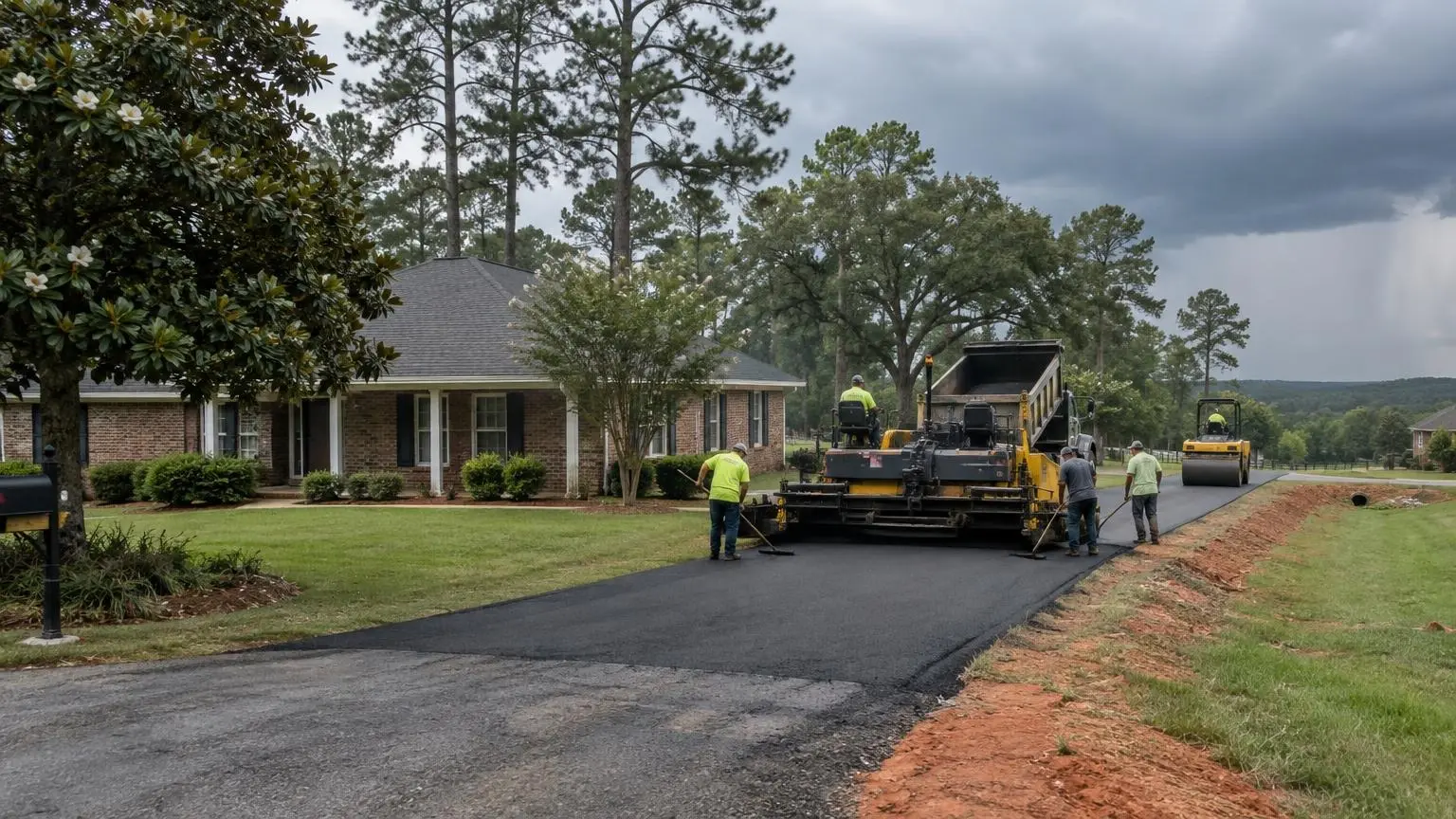
Asphalt contractors for the River Region
Asphalt Paving in Montgomery, AL
Driveways and lots built to handle long, hot summers, heavy rain and Black Belt clay.
- No-cost site visit and estimate
- Line-item written quote you can compare
- Base and drainage checked before we pave
Asphalt That Stands Up to an Alabama Summer
Asphalt paving in Montgomery has to survive heat more than cold. The city averages 86 days a year above 90 degrees and nearly four above 100, while it sees only about three nights a year below 20 degrees and less than half an inch of snow. Rain is the other constant: about 51 inches spread over more than 100 days, with February, March and July the wettest months. Asphalt softens in that heat and the ground under it gets soaked. A driveway or parking lot that lasts here has enough thickness to resist rutting and a base that stays firm when it is wet.
Black Belt clay
Montgomery sits on the Gulf Coastal Plain along the Alabama River, at the edge of the Black Belt, the band of dark, clay-rich prairie soil that runs across central Alabama. The USDA describes Black Belt clays such as the Vaiden series as very fine smectitic clay over chalk, very slowly permeable and saturated within a foot or two of the surface in winter and spring. Smectite clays swell when they take on water and shrink as they dry, which heaves and cracks pavement that sits on a thin base. Not every lot has those soils, but many do, especially south and west of the city.
How we build for it
- Strip topsoil and dig out soft or wet clay in the driveway path
- Place compacted crushed stone, commonly 6 to 8 inches under a home driveway and more under truck traffic
- Compact asphalt to the thickness in your quote, typically 2 to 3 inches residential and 4 or more commercial
- Grade so water runs off the surface and away from the base
- Support the edges so they do not crumble into the yard
Heat and timing
Hot-mix asphalt has to be compacted while it is still workable. In Montgomery summers, that is easy in the morning and harder in the late afternoon, when new asphalt is also most easily marked by tires. We start early, keep traffic off until the surface cools, and give you clear instructions: no turning the wheel in place, no kickstands or jack stands without a board, and varied parking for the first season.
Old neighborhoods and new suburbs
Montgomery was incorporated in 1819 and has been Alabama's capital since 1846. Its older districts, such as the Garden District and Cloverdale, have narrow drives and mature trees. Around it, places like Pike Road, Prattville and Millbrook have grown fast, with new subdivisions on freshly graded clay. Each needs a different approach, and the town pages explain what we see in each.
Repair, reseal or rebuild?
Not every tired driveway needs replacing. If the surface is gray and has a few cracks but stays firm underfoot, crack filling and a seal coat can buy years. If it has a few potholes on an otherwise sound base, saw-cut patches fix them. When cracks connect into a web, ruts hold water and the edges are breaking up, the base has failed, and a rebuild is the better value. We explain which category your pavement is in at the estimate.
Permits
Work that reaches the street, curb or sidewalk, or connects to a state highway, may need approval from the city, the county or the Alabama Department of Transportation. We confirm what applies to your address before scheduling.
Communities We Serve
Our home base is Montgomery, and we work across the River Region: Prattville, Millbrook, Wetumpka, Pike Road, Elmore, Coosada, Deatsville, Eclectic, Tallassee and Autaugaville to the north and west; Hope Hull, Hayneville, Lowndesboro and Fort Deposit to the south; Shorter, Tuskegee, Union Springs, Auburn and Opelika to the east; and Selma, Troy and Clanton farther out. Soil changes from Black Belt clay in the south and west to sandier and rockier ground near the Fall Line around Wetumpka, Tallassee and Auburn. The town pages cover the details.
- Asphalt Paving in Montgomery, AL
- Asphalt Paving in Prattville, AL
- Asphalt Paving in Millbrook, AL
- Asphalt Paving in Wetumpka, AL
- Asphalt Paving in Pike Road, AL
- Asphalt Paving in Tallassee, AL
- Asphalt Paving in Tuskegee, AL
- Asphalt Paving in Auburn, AL
- Asphalt Paving in Opelika, AL
- Asphalt Paving in Selma, AL
- Asphalt Paving in Hope Hull, AL
- Asphalt Paving in Deatsville, AL
- Asphalt Paving in Eclectic, AL
- Asphalt Paving in Troy, AL
- Asphalt Paving in Elmore, AL
- Asphalt Paving in Coosada, AL
- Asphalt Paving in Hayneville, AL
- Asphalt Paving in Union Springs, AL
- Asphalt Paving in Clanton, AL
- Asphalt Paving in Shorter, AL
- Asphalt Paving in Autaugaville, AL
- Asphalt Paving in Fort Deposit, AL
- Asphalt Paving in Lowndesboro, AL
Our Services
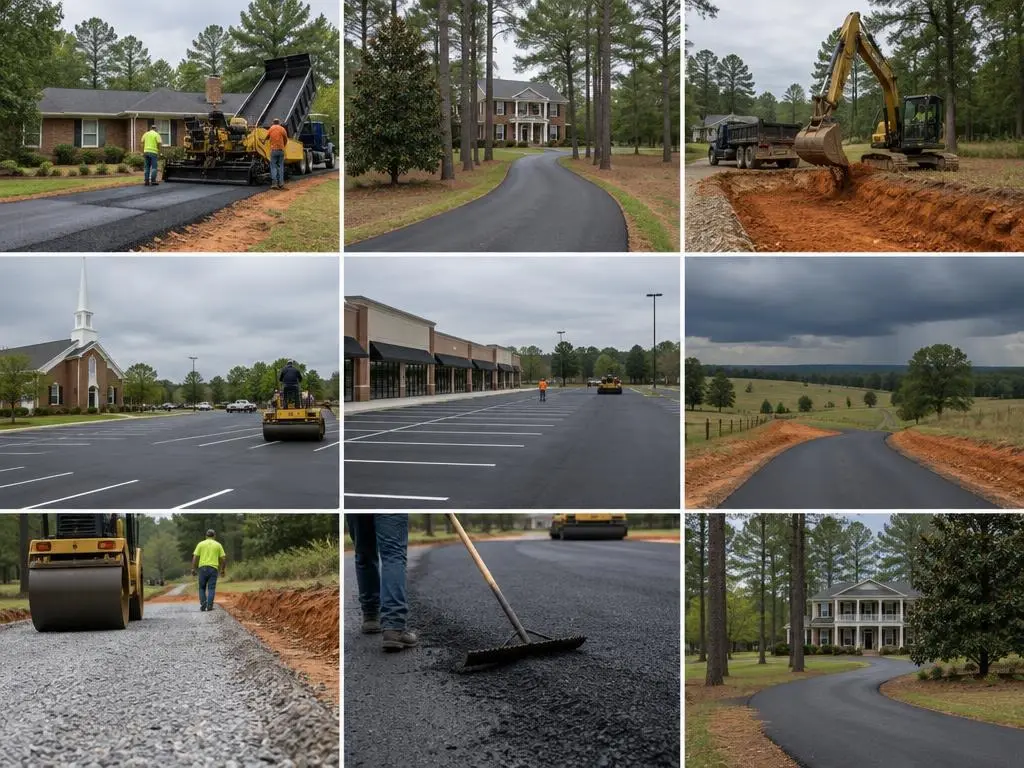
Six services covering asphalt from the first lift to the years of upkeep after it.
Asphalt Driveways
New asphalt driveways and full replacements, with clay dug out and a compacted stone base underneath.
Learn more →Commercial Paving
Asphalt parking lots and private drives for businesses, churches and apartments, planned for traffic and drainage.
Learn more →Asphalt Overlays
A fresh layer of asphalt over pavement that is worn but still sound, often with milling and repairs first.
Learn more →Seal Coating
A protective coat that keeps sun and water from aging asphalt, applied on cured pavement in dry weather.
Learn more →Pothole Repair
Potholes, cracks and failed spots fixed at the base, so the repair holds through the next wet season.
Learn more →Parking Lot Striping
Stall lines, accessible spaces, arrows and fire lanes on new or resealed lots.
Learn more →Common Questions
How much is asphalt paving in Alabama?
National guides put new asphalt driveways at about $5 to $12 or more per square foot (HomeGuide) and $7 to $15 (Angi), and commercial lots at about $2 to $4.50 per square foot (HomeAdvisor). A 400-square-foot driveway falls around $2,000 to $4,800 in HomeGuide's figures. Removal, base repair on clay and access change the total.
What is the best time of year to pave in Montgomery?
Spring and fall are easiest, with warm ground and less extreme heat. Summer paving works with early starts. Winters are mild enough that paving is often possible on dry, warmer days.
How thick should my driveway be?
A common residential build is 2 to 3 inches of compacted asphalt over 6 to 8 inches of compacted stone. On soft clay or for heavy trucks, more base and asphalt are needed.
Asphalt or concrete for a Montgomery driveway?
Asphalt costs less up front and is easier to patch; concrete costs more and lasts longer, about 30 to 40 years against 15 to 30 for asphalt in HomeGuide's figures. On moving clay, both crack if the base is poor.
How soon can I seal a new driveway?
HomeGuide recommends waiting 3 to 6 months after paving so the asphalt can cure. Seal in dry weather between about 50 and 95 degrees.
Why did my driveway crack after one summer?
Usually a thin base or wet clay underneath. Clay that swells and shrinks moves the pavement, and a thin base cannot bridge it. Rebuilding the base is the lasting fix.
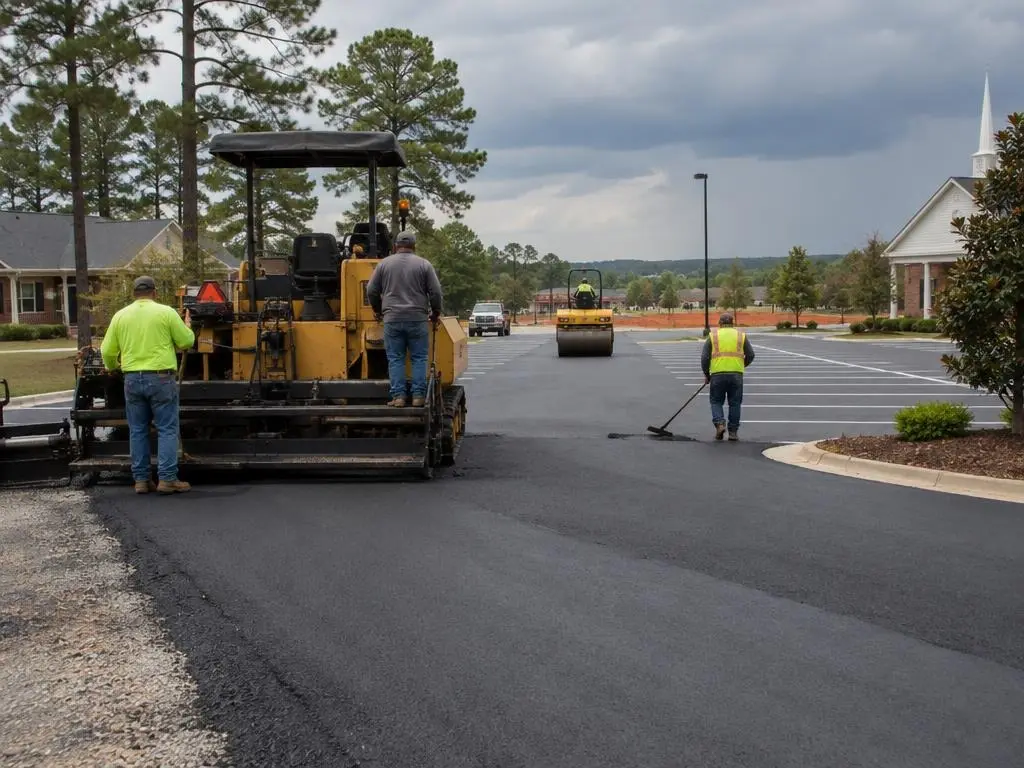
Why Homeowners Call Asphalt Paving Montgomery
Built for heat
Asphalt thickness set so the surface resists rutting through 90-degree summers.
Clay taken seriously
Soft clay removed and replaced with compacted stone before paving.
Line-item quotes
Removal, base, asphalt and finish work priced separately so you can compare bids.
Scheduled around weather
Base work in dry spells, paving in the cooler part of the day.
Request an Asphalt Paving Estimate
Free site visits in Montgomery and across the River Region.